What do I hold right now? Four stages of thinking with AI
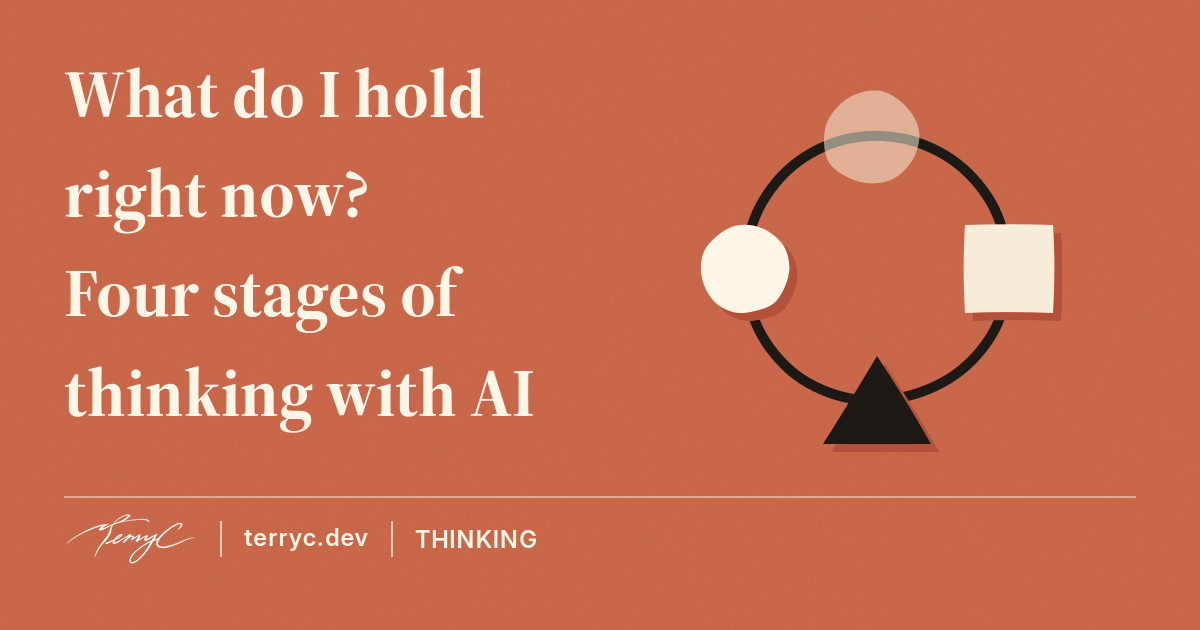
AI answers a vague question as smoothly as a clear one. A map of four stages, and one question that tells you which stage you are in.
Ask an AI a vague question and it answers smoothly anyway. Ask it whether your plan is good and it mostly says yes.
It does not tell you that you sent the wrong kind of question for where you are.
So I keep a small map: four stages, with nine saved instructions.
What a “thinking skill” is
A skill, in the tools I use, is a set of instructions saved under a name. When I call the name, the AI follows those instructions instead of answering off the cuff.
Three house rules run through all nine:
- They wait to be asked. Most start only when I call them. Two may offer themselves in one line, once.
- They do not do the task. They work on the thinking around it.
- I decide. They give analysis and a recommendation, then stop.
You do not need my setup: each stage post has a prompt you can paste into any chat.
The four stages
- Get clear:
/reframe, Brainstorming,/shape. A feeling you cannot name becomes a brief: what you want, what is in, what is out, and how you will know it is done. Get clear: name the problem before you ask for answers. - Decide: Council,
/premortem. You make the call, then try to break the plan before committing. Decide: make the call, then try to break the plan. - Do it:
/sharpen, and a “done when” line. You hand the work over with a deeper request. Do it: a deeper request, and a line that says when it is done. - Learn back:
/lookback, Knowledge Capture, Continuous Learning. You compare the plan with the result and keep three lessons at most. Learn back: three lessons at most from finished work.
One question finds the stage
What do I hold right now?
- A feeling, a question, or a direction with no edges: stage 1.
- A brief with a choice still open, or a chosen plan I have not committed to: stage 2.
- A decision I can act on: stage 3.
- A result: stage 4.
Not sure? Can I say in one sentence what I want and how I will know it is done? If not, I am in stage 1.
One case, all the way through
The four posts follow one case across the map.
The case is my own kind of work: I want to get better at working with AI, and I think writing in public about what I learn would force me to learn properly.
It starts as a feeling: I read a lot about AI and little of it sticks. It becomes a brief for a four-week writing trial, then a tested plan, then one job handed to an AI, then a look back.
The plan and its rules come from my own notes. The answers and results in the story are illustrative. They show what each skill produces, not what happened.
Why not just ask the AI directly
Asking directly works for small things.
It goes wrong when my question belongs to an earlier stage than the one I am in. I ask for a posting schedule when I have not named the problem. I ask “is this good?” about a plan I have already fallen for. The reply is fluent both times.
A usual order, not a law
Small jobs skip stages. Sometimes “should I do this at all?” comes first and the brief comes after. One gap remains: nothing on the map breaks a big job into ordered steps. I do that by hand.
Where these ideas come from
Two of the skills, /reframe and /sharpen, are adapted from pstack, a public set of agent skills. /brainstorming is adapted from Superpowers (MIT, Jesse Vincent). /continuous-learning is adapted from Everything Claude Code (MIT, Affaan Mustafa). The other five skills, and the map and the stage question, are my own.
Start with stage 1: Get clear: name the problem before you ask for answers.