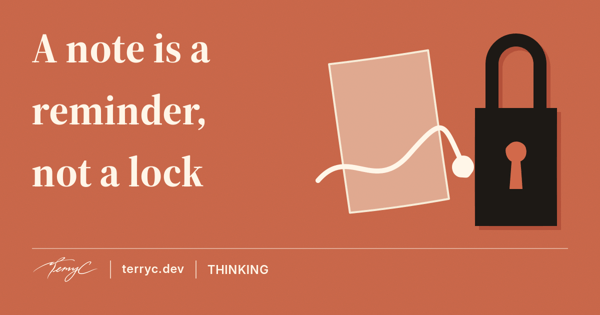
A note is a reminder, not a lock
Written instructions help an AI remember how you work, but they do not force it. For a rule that must never be broken, you need a lock, not a note.

Category
How I think about problems, systems and work.
Written instructions help an AI remember how you work, but they do not force it. For a rule that must never be broken, you need a lock, not a note.
One answer hides the choice that was made for you. Ask for three options, each with what it costs, and the trade-offs come into view.
Most jobs that come back wrong were briefed in one line. Four short parts, said before the work starts, save a second round.
A chat with an AI is short-term memory. Write the conclusion as a short note, put it in a folder, and it is still there next month — even if you switch to another AI.
Some jobs need a person who will stand behind the result: the decision, the signature, the apology. Five to keep, and the preparing you can hand over around each.
ThinkingSeries: Thinking skills 3 of 5
Stage two of four. Council walks a "should I" question through fixed sets of questions. /premortem assumes the chosen plan has failed and works backwards.
ThinkingSeries: Thinking skills 4 of 5
Stage three of four. Most of this stage is doing, not thinking. Two small things carry the thinking: the four questions of /sharpen, and a "done when" line.
A contract, a quotation or a form written by someone else reads smoothly and hides the parts that matter. Five plain questions to answer before you sign.
ThinkingSeries: Thinking skills 2 of 5
Stage one of four. Three ways to turn a feeling into a brief: learn the right words, ask why until the real need shows, then write down what is in and what is out.
Doing it yourself is quicker today and slower every week after. How to pick the first job to delegate, and how to hand it over so it stays handed over.
A new chat will happily suggest the idea you killed last week. Keep a short list of what you tried, what you turned down, and the reason.
ThinkingSeries: Thinking skills 5 of 5
Stage four of four. Compare what was planned with what happened, keep at most three lessons in the form "when X, do Y", and put each one where it will be found.
Five helpers that all help with everything are a committee. Give each one a job and a list of what it leaves alone, and the work stays readable.
Whoever wrote something tends to defend it. For a second look, open a new chat, paste only the result, and ask what is wrong. It costs a minute.
ThinkingSeries: Thinking skills 1 of 5
AI answers a vague question as smoothly as a clear one. A map of four stages, and one question that tells you which stage you are in.